
Energy you can feel. outcomes you can see!
Interactive drumming pulls a room into shared attention fast. From there, we build cohesion, energy and cooperation. Our sessions follow a deliberate architecture: a sequence of cues and activities designed to produce reliable group outcomes.
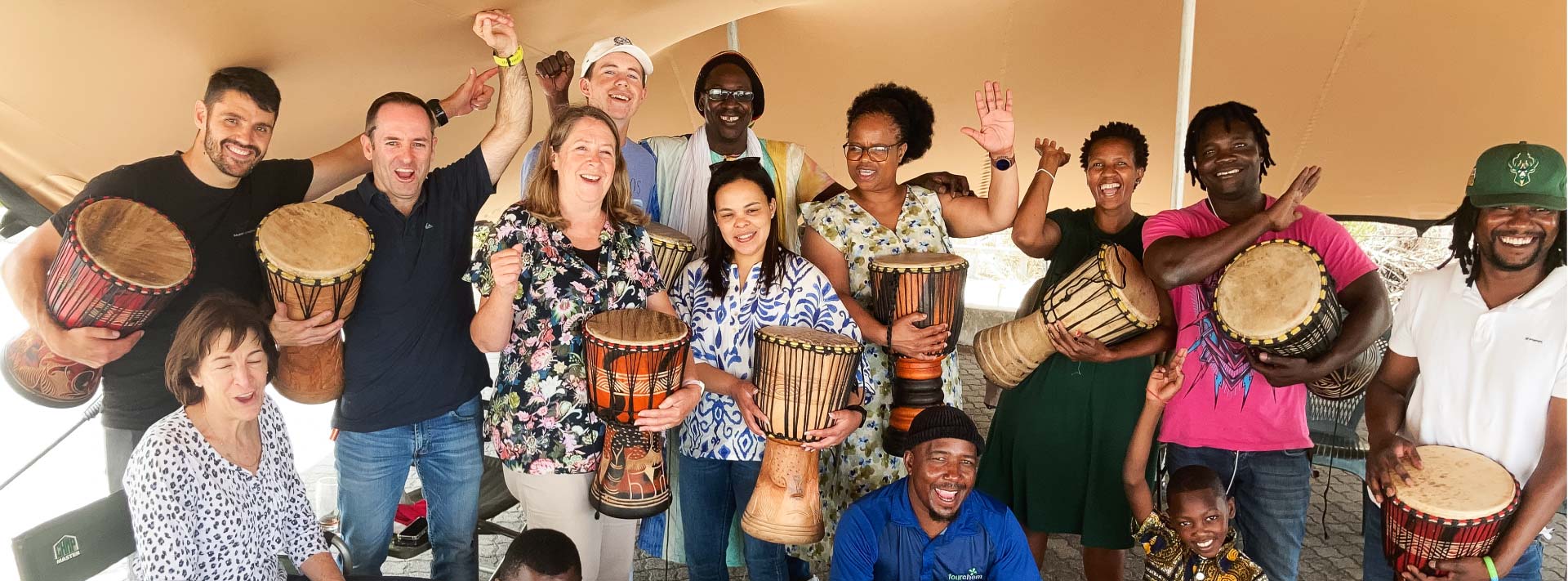
The core advantage: full-group presence
When a group is facilitated into rhythm, attention becomes collective.
Researchers describe this as sensorimotor synchronisation, the rhythmic coordination of perception and action, most conspicuously in music performance. To stay in time, participants must continuously listen, predict and correct timing. That ongoing loop makes distraction costly because the feedback is immediate and shared. You can hear it instantly – when attention drifts, the groove loosens; when attention returns, the group snaps back into time.
In practice: interactive drumming strongly constrains attention in a way that other team-building activities cannot. It is not that people are forced to engage. It is that the structure of the task makes presence the easiest option.
What full-group presence unlocks
When full-group presence is achieved, you can build outcomes that most team activities struggle to reach – quickly and inclusively.
Faster cohesion
A large, semi-naturalistic study tracking newly formed adult education classes found that singing groups bonded faster than non-singing groups (crafts or creative writing). Interactive drumming uses closely related mechanisms – synchrony, shared attention and a collective outcome – to create rapid social ease among relative strangers.

More cooperation
Synchrony has been shown experimentally to increase cooperative behaviour. A meta-analysis of 60 experiments reports a medium overall effect of interpersonal synchrony on prosocial outcomes (attitudes & behaviours), with intentionality and actively trying to coordinate, as a key moderator.
Elevated mood and group “lift”
In a controlled study, active music-making (including drumming) was associated with endorphin release as indexed by increased pain tolerance, alongside increased positive affect, whereas merely listening to music and low-energy musical activities did not show the same pattern. This is one reason interactive drumming is such a reliable energiser: it changes state through action.
A measurable “reset” signal
A controlled study of group drumming reported increases in DHEA-to-cortisol ratio and increases in natural killer cell activity after drumming. This is supportive context rather than a health claim, but it reinforces the wider point: structured group rhythm can shift arousal and stress-related physiology.

High-level energy that lifts the room

I didn’t expect to enjoy it so much. Amazing how energised the team was for the rest of the day.
Conference Delegate
What we are optimising – the mechanisms
Sensorimotor Synchronisation
Shared rhythm requires prediction anda correction
Prosocial Uplift
Synchrony predicts prosocial outcomes at scale across studies
Shared Intentionality
Collaboration amplifies synchrony’s cooperative effects
Mood & Energy Shift
Active performance elevates positive affect and enhanced state.
This is why interactive drumming can function as an ice-breaker, energiser, team builder and unifier in one experience – quickly, inclusively and without needing people to be extroverted or familiar with playing music.
A deeper look at what happens when we drum together
Kabako’s interactive drumming does not only change the vibe in the room. Because it is rhythmic, physical and shared, it activates neurochemical systems linked to uplift, motivation, regulation and social bonding. That is why people feel the shift immediately – they do not just think differently, they feel different.
Endorphins
The body’s natural feel-good response to rhythmic, physical activity.Associated with uplift, release of tension and a noticeable rise in overall wellbeing.
Serotonin
Commonly associated with mood stability and regulation. Shared rhythm and steady repetition helps the nervous system settle, supporting calm focus and contentment.
Dopamine
Linked to reward and motivation. As the group locks into a groove, it reinforces enjoyment, attention and the sense of progress that keeps people engaged.
Oxytocin
Often described as a bonding hormone. Participating together, listening closely and succeeding as a group strengthens trust, empathy and a genuine sense of belonging.
This is the “why” beneath the feeling: group rhythm engages body and brain together, making connection easier and collaboration more natural.
Why our method works: facilitation architecture, not an activity!
Synchrony does not automatically equal connection. The research indicates that shared intentionality, actively collaborating to produce joint action strengthens the cooperative impact of synchrony. Kabako designs sessions to convert synchrony into cohesion by engineering shared intentionality, interdependence and collective achievement.